The reason your HVAC shop loses emergency calls to competitors with fewer reviews
The Reason Your HVAC Shop Loses Emergency Calls to Competitors with Fewer Reviews
It is 2:00 AM in the middle of a record-breaking heatwave. A homeowner wakes up in a sweat because their central AC unit has finally kicked the bucket. They reach for their phone, type “emergency AC repair near me” into Google, and look at the Local Map Pack. You, the established HVAC authority in town, have 520 reviews and a stellar 4.9-star rating. Your competitor, a guy with a van and a small office three miles closer to the homeowner, has only 42 reviews and a 4.3-star rating.
Logic suggests you should get the call. After all, you’ve spent years building a reputation, gathering testimonials, and providing top-tier service. But you don’t get the call. In fact, you aren’t even on the first page of the Map Pack. The homeowner clicks the first result they see – the guy with 42 reviews – and within thirty minutes, your competitor is earning the emergency dispatch fee and a potential lifelong customer.
This is the Review Paradox. Many HVAC owners believe that reviews are the ultimate trump card in google business profile seo. While reviews are vital for conversion, they are only one small piece of the ranking puzzle. If you are wondering why your massive review count isn’t translating into #1 rankings, you are likely falling victim to Google’s core local algorithm priorities: Relevance, Distance, and Prominence. In this guide, I’m going to break down exactly why you’re losing those high-ticket emergency calls and how to fix your local search visibility.
Section 1: The Three Pillars of the Local Algorithm
To understand why you are being outranked, we have to look under the hood of the Google Maps algorithm. Google officially states that local results are based primarily on three factors: Relevance, Distance, and Prominence. Understanding how these pillars interact is the first step toward effective google business profile seo.
1. Relevance
Relevance is how well a local business profile matches what someone is searching for. If a user searches for “emergency furnace repair,” Google looks for signals that your business actually performs that specific service. If your profile only mentions “HVAC Contractor” generally, but your competitor has “Emergency Furnace Repair” mentioned in their services, their website, and their recent reviews, Google views them as more relevant to that specific query.
2. Distance (Proximity)
This is the silent killer for large HVAC shops. Distance refers to how far each potential search result is from the location term used in a search. If a user doesn’t specify a location (e.g., just “AC repair”), Google calculates distance based on what it knows about their location. For emergency queries, Google’s “proximity filter” tightens significantly. To help you rank google business profile higher, you must understand that Google prioritizes the speed of service for the user. If a competitor is physically closer to the searcher, Google often assumes they can solve the “emergency” faster, even if they have fewer reviews.
3. Prominence
Prominence refers to how well-known a business is. This is where your 500+ reviews come into play. It also includes information that Google has about a business from across the web, like links, articles, and directories. However, prominence is often weighted *after* relevance and distance. If you are 10 miles away and your competitor is 2 miles away, your prominence may not be enough to bridge that gap in an emergency search scenario. According to Google Support, prominence is also based on your position in web results, which is why your organic SEO directly impacts your Map Pack ranking.
Data shows that 88% of HVAC-related searches are local and often intent-driven. When the intent is “emergency,” the algorithm shifts its weight toward distance and immediate relevance, often leaving the “prominent” businesses in the dust. To combat this, you need a specialized google maps ranking service that focuses on expanding your “proximity radius” through technical signals rather than just review acquisition.
Section 2: Why “Emergency” Keywords Change the Rules
Not all keywords are created equal. In the HVAC world, there is a massive difference between “HVAC installation quotes” and “AC repair near me now.” The first is a research-heavy keyword; the second is an action-heavy, emergency keyword.
When a user is looking for a new furnace installation, they are likely sitting at a desk, comparing three or four companies, reading long-form reviews, and checking galleries. In this scenario, Google may show a wider geographic range of businesses because it knows the user is willing to wait and research. Your 500 reviews are a massive asset here.
However, for emergency keywords, the rules change. For a homeowner in 100-degree heat, the search is a “micro-moment.” They aren’t looking for the *best* company in the state; they are looking for the *nearest qualified* company that is open right now. This is where google business profile optimization becomes critical. If your profile isn’t explicitly set to “Open 24 Hours” or doesn’t have “Emergency Services” as a primary sub-category, you are effectively invisible for these high-value calls.
Many HVAC owners fail to realize that nearby competitors with fewer reviews are outranking them simply because they have better “Open Now” signals and specific service-area declarations that tell Google they are ready to respond immediately. If your competitor has optimized their profile for “Emergency AC Repair” as a service and you haven’t, their 40 reviews will beat your 500 reviews every single time the temperature spikes.
Section 3: The “Entity Trust” Gap
If you have the reviews and you are relatively close to the searcher, but you *still* aren’t ranking, you likely have an “Entity Trust” gap. Google doesn’t just look at your Google Business Profile (GBP); it looks at your entire digital footprint to verify that you are who you say you are and that you are a trusted local authority.
NAP Consistency and Citations
Your Name, Address, and Phone number (NAP) must be identical across the internet. If your website says “Main St. HVAC,” your GBP says “Main Street Heating & Cooling,” and your Yelp says “Main St. HVAC Specialists,” Google gets confused. In the world of google business profile ranking factors, consistency equals trust. A competitor with fewer reviews but a perfectly synchronized NAP across 50 high-quality local directories will often outrank a “messy” established business. This is why utilizing local seo tools to audit your citations is non-negotiable.
The Website-to-Map Synchronization
Your website is the “brain” of your Google Business Profile. If your website doesn’t have dedicated pages for each city you serve, or if it lacks [local business schema], Google has a harder time connecting your business to specific geographic areas. Your competitor might be winning because their website is technically superior at signaling local intent. They likely use localized content, geo-tagged images, and schema markup that explicitly tells Google’s crawlers, “We serve this specific neighborhood.”
I often see HVAC shops making citation mistakes that make their map pin look like a scam. If Google detects conflicting information about your physical location or service area, it will suppress your profile to protect the user experience. Reviews cannot fix a broken foundation of entity trust.
Section 4: 2026 Proximity Filters & “Ghost” Interactions
As we move toward 2026, the algorithm is becoming even more sophisticated. Google is now using “Neural Mapping” to understand the flow of traffic and user behavior in real-time. This has led to what I call “Ghost Interactions.”
A “Ghost Interaction” occurs when a user sees your profile but doesn’t click, or clicks and immediately bounces back to the search results. Google tracks these micro-behaviors. If people are clicking on your competitor’s profile because it features a “Get a Quote” button or a “Call Now” button that is more prominent, Google perceives that profile as more useful. This builds google business profile engagement, which is a massive ranking signal that bypasses review count.
The 2026 Proximity Filter
Google is increasingly filtering out “Service Area Businesses” (SABs) that claim too large a territory without having the physical signals to back it up. If you are an HVAC shop claiming a 50-mile radius but all your reviews and website traffic come from a 5-mile radius, Google may “filter” you out of searches in the outer 45 miles. This is a move to prevent “map spam.”
To stay ahead, you must implement tactics to beat 2026 proximity noise. This includes uploading localized photos from jobs in those outer areas and encouraging customers in specific zip codes to mention their city in their reviews. Google’s AI can now read the text within reviews to verify your service area, making keyword-rich reviews more valuable than a simple 5-star rating with no text.
Section 5: How to Reclaim Your Map Position
If you are ready to stop donating your emergency leads to the competition, you need to move beyond review collection and start focusing on advanced local seo services. Here is your checklist for reclaiming the Map Pack:
1. Audit Your Categories
Your “Primary Category” should be “HVAC Contractor.” However, your “Secondary Categories” are where the magic happens. Ensure you have “Air Conditioning Repair Service,” “Heating Contractor,” and “Air Conditioning Installation Service” selected. If you offer 24/7 service, ensure your hours reflect that accurately. Google uses these categories as the primary filter for relevance.
2. Use Heat Maps for Geographic Insights
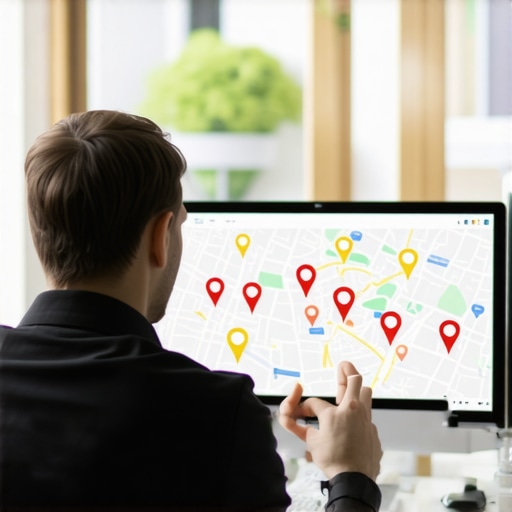
Don’t guess where you rank. Use local seo software to generate a “search heat map.” This tool shows you exactly where your ranking drops off. If you are #1 in your zip code but drop to #10 just two miles away, you know you have a proximity and signal strength issue, not a review issue. This allows you to target your SEO efforts on specific “weak” zones.
3. Optimize for Service Area Businesses (SAB)
If you don’t have a storefront where customers visit, you must set up your SAB settings correctly. Do not over-extend your service area. It is better to dominate a 10-mile radius than to be invisible in a 50-mile radius. Use your website to create “Service Area Pages” that link back to your GBP to reinforce your local authority.
4. Implement a Keyword-Driven Review Strategy
Stop asking for “a review.” Start asking for “a review that mentions the service we did.” A review that says “Faisal fixed my AC in [City Name] at 3 AM” is worth ten reviews that just say “Great service!” These keywords help you rank higher on google maps for those specific emergency queries because they provide the “Relevance” signal Google craves.
5. Increase Interaction Depth
Use the “Updates” feature on your Google Business Profile at least twice a week. Post photos of your team, current promotions, and helpful tips. This signals to Google that your profile is active and managed, which increases your “Interaction Depth” and helps you stand out against stagnant profiles. If you aren’t sure how to do this, consider a google maps ranking service to handle the heavy lifting of profile management.
For more advanced moves, check out the first three changes we make to get a profile ranking by Friday. These quick wins often involve cleaning up category conflicts and fixing broken website links that are dragging down your map authority.
Conclusion: Reviews Close the Deal, SEO Gets the Call
The hard truth is that reviews are a “conversion” factor, not a “visibility” factor. Your 500 reviews are the “social proof” that convinces a homeowner to call you *after* they find you. But if you aren’t in the Top 3 of the Map Pack, they will never see those reviews in the first place.
Google maps seo is the engine that gets you invited to the table. In the high-stakes world of HVAC emergency calls, proximity and relevance will always beat sheer volume. If your shop is losing out to smaller competitors, it’s because their digital signals are tighter, their proximity is favored, or their entity trust is more clearly defined in Google’s eyes.
Stop guessing why your phone isn’t ringing when the heat is on. It’s time to stop focusing solely on the “stars” and start focusing on the “signals.” Whether you choose to hire SEO pros or use a specialized google business profile seo tool, the goal is the same: dominate the map so you can dominate the market. If you aren’t in the Top 3, you’re just a spectator in your own city.